Automatic gate safety: what BS EN 12453 means for your gate
The safety standard for powered gates in the UK explained: force limits, photocells, safety edges, who is responsible, and what a force test involves.
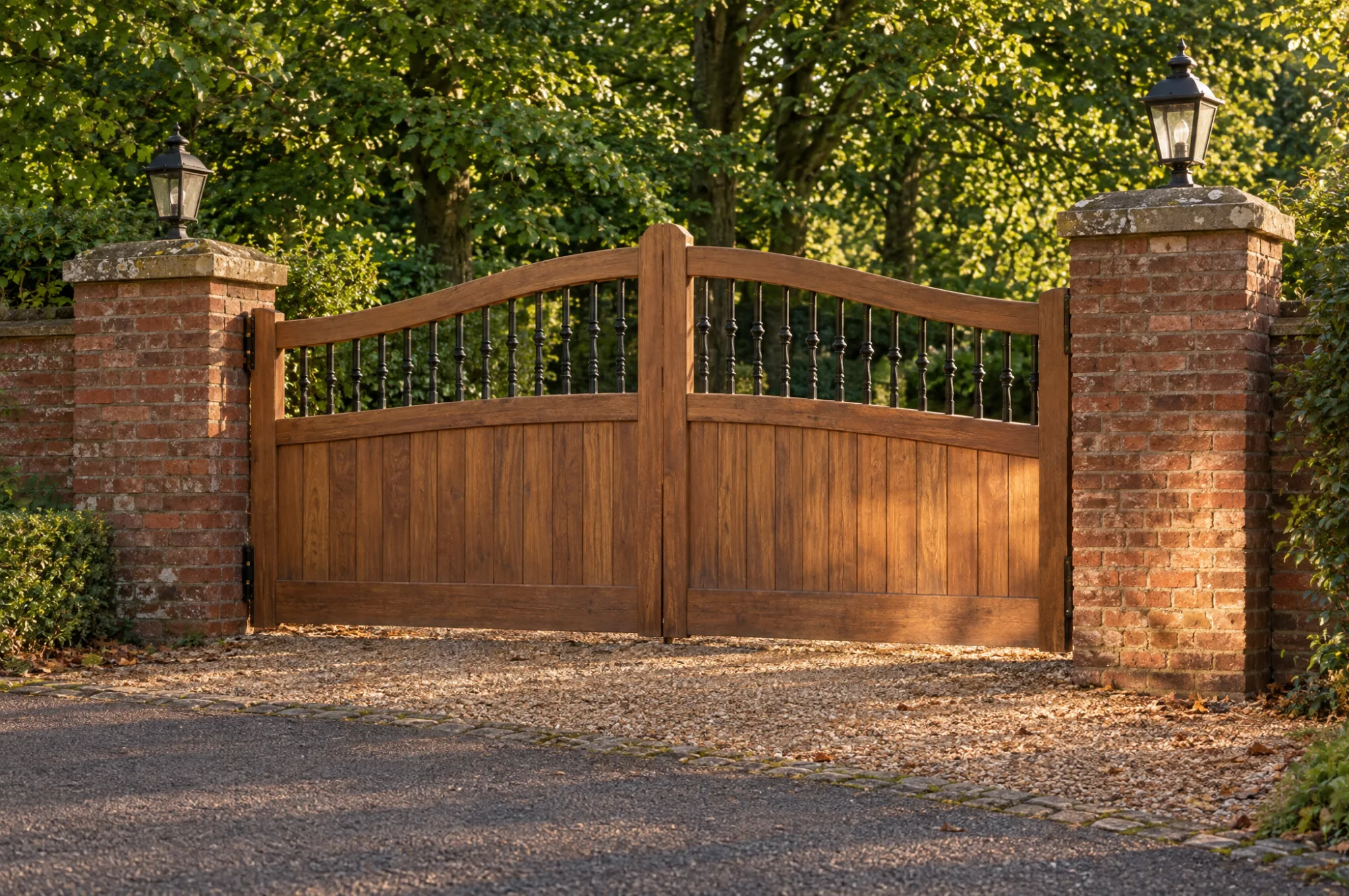
A powered gate is a machine, and in the UK it must be safe to the standard set out in BS EN 12453. This matters because gates that were not, have killed people, including two children in 2010 whose deaths changed how the industry works. Here is what the standard requires in plain terms and what it means for you as an owner.
What the standard covers
BS EN 12453 (last substantially revised in 2017) sets out how powered gates, barriers and doors must protect people from crushing, shearing, impact and drawing-in hazards. It applies to every powered gate, domestic or commercial, new or old. The operators and safety edges themselves must carry a CE or UKCA mark with a manufacturer's declaration of conformity, and the completed gate is a machine under the Supply of Machinery (Safety) Regulations 2008.
Force limitation
The gate must stop and reverse when it meets a person. The standard sets maximum forces at defined points: a peak of 400 N for crushing, shearing and draw-in hazards, generally where the closing gap is 500 mm or less, and 1,400 N for impact-only hazards where no one can be trapped, generally where the gap is over 500 mm, in each case dropping to 150 N within 0.75 seconds and to 25 N or less within 5 seconds. These numbers are measured with a calibrated force tester, not judged by hand. That measurement is the force test we carry out on every installation and repair.
Safety devices
Force limitation alone is rarely enough. Depending on the gate, the standard expects:
- Photocells (light beams) across the opening, commonly fitted at two heights and, on sliding gates, active on both sides where the gap to the post exceeds 150 mm.
- Safety edges, the soft rubber strips on leading and trailing edges that stop the gate on contact.
- Guarding of gaps that could trap a hand between a sliding gate and its post or fence.
- Guarding of hinge gaps on swing gates, or hinge designs that avoid them.
- A warning lamp where the gate is operated out of sight.
Who is responsible
The installer is responsible for handing over a safe, tested gate with documentation. After that the owner is responsible for keeping it safe, which in practice means annual servicing and a force test. For landlords, factors, schools and businesses this is a legal duty under the Health and Safety at Work Act and the Provision and Use of Work Equipment Regulations. Insurers increasingly ask for the certificate.
Older gates
Gates installed before 2010 often have no photocells or edges at all. They are not exempt. We can usually bring an older gate up to standard with photocells, edges and a modern control board for a few hundred pounds, which is far cheaper than a new system.
What a force test involves
An engineer measures the force at several points across the travel of each leaf with a calibrated instrument, checks every safety device, inspects guarding and hinges, and issues a certificate recording the results. It takes about an hour and forms part of our annual service.
If you are unsure whether your gate is safe, ask us to check it.